

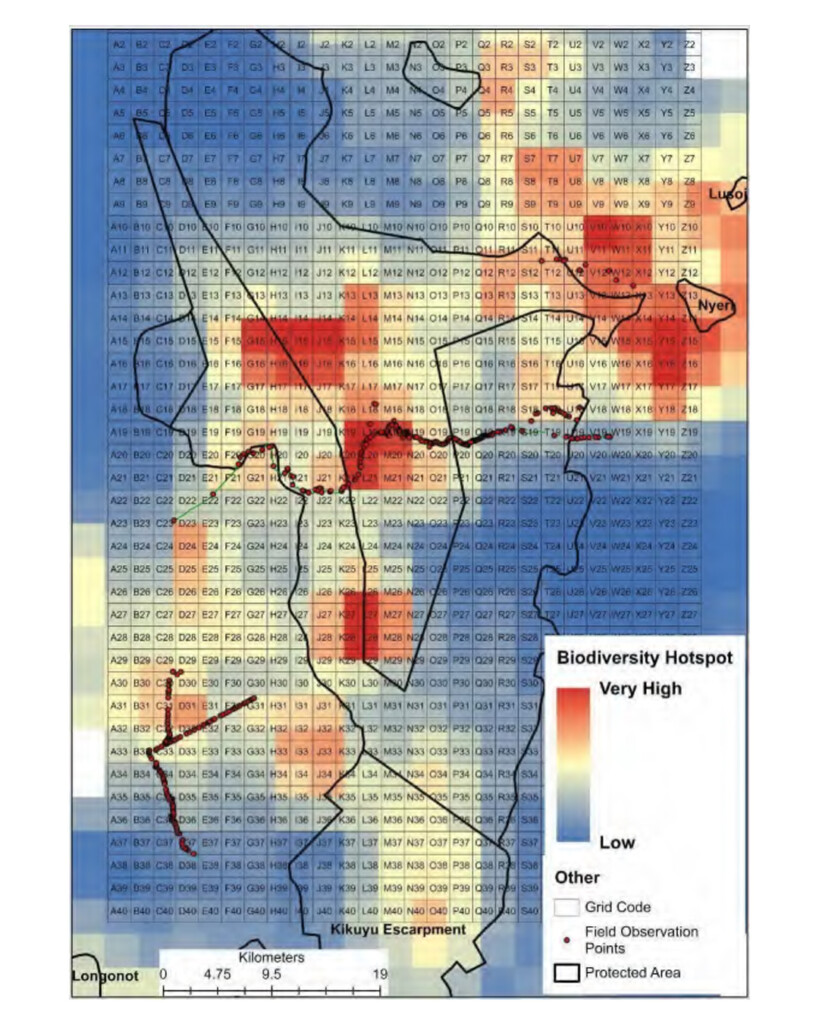
The Aberdare Forest is a globally recognized biodiversity stronghold. Spanning altitudinal gradients from 2,000 to 4,000 meters above sea level, it supports a wide range of endemic and threatened species, high levels of endemism, and critical ecosystem services that sustain human and ecological communities downstream. However, these irreplaceable values are now under acute threat from the proposed Ihithe – Ndunyu Njeru highway, which is slated to bisect the heart of the Aberdare ecosystem.
Despite arguments promoting economic and infrastructural development, the proposed road poses substantial and well-documented threats to biodiversity, ecosystem function, and climate regulation.
1. Direct & Indirect Biodiversity Loss
a. Habitat Destruction and Fragmentation
The construction of a road corridor through intact forest inevitably leads to deforestation, fragmentation of core habitats, and the loss of microhabitats critical to species such as amphibians, small mammals, and epiphytic flora. A projected 104 hectares of land will be cleared, including 5,662 Mg ha⁻¹ of above-ground biomass, leading to massive carbon emissions and the destruction of critical vegetation zones (AWEMAC, 2017).
The fragmentation effect extends far beyond the road itself. Research shows that road-effect zones—defined by Forman and Alexander (1998)—can extend up to 1 km on either side of a road, altering plant-animal interactions, reducing gene flow, and increasing edge effects such as light penetration, wind desiccation, and invasive species colonization.
b. Faunal Displacement and Mortality
Road development within the Aberdares will disturb movement corridors for large mammals like African Elephants, leopards, antelopes, and potentially Eastern Black Rhinos. Excavations, machinery noise, and physical barriers such as trenches will disrupt traditional migration and foraging paths. Research from Eigenbrod et al. (2009) on amphibians demonstrates that road-effect zones can lead to significant population declines, especially during breeding migrations.
Moreover, road traffic increases the risk of direct wildlife-vehicle collisions, particularly for low-flying birds, reptiles, and nocturnal mammals, many of which have slow reaction speeds or are attracted to road edges.
2. Impacts on Rare &Threatened Species
The Aberdare ecosystem harbors numerous species of conservation concern, including:
- African Elephant (Loxodonta africana) – Vulnerable
- Sharpe’s Longclaw (Macronyx sharpei) – Endangered
- Jackson’s Widowbird (Euplectes jacksoni) – Endangered
- Aberdare Cisticola (Cisticola aberdare) – Endemic
- Montane Dancing Jewel (Platycypha amboniensis) – Critically Endangered
The Grey-crowned Crane (Balearica regulorum), listed as Vulnerable, was documented in multiple sections adjacent to the road. Many of these taxa are forest-dependent or wetland-dependent specialists, whose population viability is tightly linked to habitat quality and continuity.
3. Road Construction as a Catalyst for Invasive Species
Road construction is a known vector for the introduction and spread of alien invasive plant species (Parendes & Jones, 2000). Disturbed soils, increased light penetration, and movement of construction vehicles create ideal conditions for colonization by opportunistic species that outcompete native flora. This further modifies soil chemistry, fire regimes, and successional patterns; degrading the long-term ecological integrity of the forest.
4. Hydrological Alteration and Aquatic Habitat Degradation
Sections of the proposed road cross drainage channels and headwater streams, risking the formation of artificial wetlands and upstream pooling due to poorly designed culverts. This disrupts natural flow regimes, alters sediment transport, and facilitates the proliferation of emergent aquatic macrophytes which can eventually choke streambeds and reduce oxygen levels; affecting aquatic invertebrate diversity and wetland bird populations.
Moreover, the siltation of wetlands, fish ponds, and earth dams downstream could irreversibly impair freshwater ecosystems that many local communities depend on.
5. Increased Human-Wildlife Conflict and Poaching Risk
As construction opens new access routes into formerly protected zones, incidences of bushmeat hunting, trophy poaching, and illegal plant harvesting are likely to surge. Rhino and elephant populations are particularly vulnerable, as the proximity of humans increases the likelihood of conflict and exploitation. Historical data shows that roads often become pipelines for illegal wildlife trade, especially in ecosystems with previously limited access (Van der Ree et al., 2011).
Disruption of electric fencing, particularly in Kiandogoro, will likely lead to elephants and wild pigs entering farmlands, damaging crops and triggering retaliation from local communities. These outcomes undermine decades of conservation investment and community engagement.
6. Long-Term Loss of Ecosystem Services
Beyond biodiversity, the Aberdares provide critical ecosystem services such as:
- Regulation of microclimates and regional rainfall patterns
- Water tower functions supporting the Tana and Ewaso Nyiro basins
- Carbon sequestration in highland forests and moorlands
- Medicinal plants and non-timber forest products vital to local livelihoods
Once these services are compromised, they are extremely costly—if not impossible—to restore.
Development Without Destruction
While infrastructure is crucial to national development, it must not come at the cost of irreversible ecological collapse. Alternative alignments that avoid the biodiversity-rich Aberdare core zone must be seriously reconsidered.
There is a precedent: globally, nations have cancelled or re-routed infrastructure projects upon realizing the scale of ecological risk. Kenya must lead by example—demonstrating that development and conservation are not mutually exclusive.
We urge stakeholders, policymakers, and the public to support the call for an immediate halt to the Ihithe – Ndunyu Njeru road and adopt the Ndaragwa – Kariamu – Ndunyu Njeru alternative, which offers connectivity without ecological compromise.
References
- AWEMAC. (2017). Environmental Impact Assessment Report – Aberdare Forest.
- Forman, R.T.T. & Alexander, L.E. (1998). Roads and their major ecological effects. Annual Review of Ecology and Systematics, 29, 207–231.
- Parendes, L.A., & Jones, J.A. (2000). Role of light, moisture, and nutrients in the colonization of exotic plant species along roads and streams in the H.J. Andrews Experimental Forest. Conservation Biology, 14(1), 64–75.
- Van der Ree, R. et al. (2011). Effects of roads and traffic on wildlife populations and landscape function. Ecology and Society, 16(1), 48.
- Eigenbrod, F., Hecnar, S.J., & Fahrig, L. (2009). Quantifying the road-effect zone: Threshold effects of road density on biodiversity. Landscape Ecology, 24, 127–135.

